Give clutter air!

Just saw a creative inspiring post on apartment therapy.  The idea is to use the Asker counter organizer from Ikea.  

NewImage

Source: Apartmenttherapy.com

Ikea Spotting has a similar desk arrangement with tons of Ikea storage tools that get the clutter up above the desk so the workers won’t see the clutter on the desk.  This does not hold the laptop up with a dish drainer (Wow!), but you can imagine yourself sitting at this desk and getting things done.  

NewImage

Source: Ikeaspotting.tumblr.com 

As I hypothesized in the post on the “good enough” home desk, I think that the surface of the desk being clear is critical to my clear headedness.  Not saying that this is for everyone, but it works for me.  

I would alter the above two desks by raising the hanging bars 6″ each.  That gives you surface to 6″ up that is clutter free.  Next, I would get all the device clutter (speakers, iPhone dock, iMac stand) off the desk with either arms or more Asker hangers.  No wires.  No clutter.  No hangups to thinking with your hands on the desk surface.  

bill meade 

Natural Planning Model: Silent Secret Weapon


NewImage

Source: Problogger.net

Introduction:

GTD’s natural planning model (Ch 3) is my silent secret GTD weapon.  

Let Me Explain:

While an undergraduate, I was plagued by writer’s block.  Then, I discovered Gabriele Rico’s (1985) WRITING THE NATURAL WAY, and the concept of “clustering” (today called mind mapping) …

Writing the Natural Way  What is Clustering

Source: Gabrielerico.com

… “trial web shift” feeling the time when mind mapping can graduate to writing, became tools for me.  Discovering the tools in WRITING THE NATURAL WAY gave me *tingles* of recognition.  I could not articulate why they were important, but I immediately knew.  

Next, I discovered Betty Edwards’ DRAWING ON THE RIGHT SIDE OF THE BRAIN which is really the drawing analog of WRITING THE NATURAL WAY.  Each book broke its domain down into a set of 5 or 6 orthogonal tools, that empowered the reader almost immediately to be able to articulate creative constructions on paper.  As I drew my own hand in perspective for the first time  ….

NewImage

Source: Praterposte

… again, I had *tingles* of recognition that I was exercising an important new skill.  

Enter time (25 years), a Ph.D., three kids, moves, jobs, 5,000 books, 94,000 pages of personal papers, and finally in 2009, GETTING THINGS DONE. All this time, mind mapping laid mostly dormant.  I had tried to incorporate mind maps in my work, but I found that I could not show them to anyone without being stereotyped as “a creative” which meant in effect “so heavenly minded, no earthly good” + “unable to follow through.”  So, I kept mind maps to myself, and gradually stopped using them.  

When at the opening of chapter 3 of GTD, I heard these words (I was listening to David Allen’s recording via Audible 

/Begin *Aside* My students say that David Allen and George Clooney sound exactly the same

Allenooney

Separated at birth?  

Source: David Allen, George Clooney 

… so if you like Clooney, you’ll love the Audible version. 

/End *Aside* 

I’ve found the biggest gap to be the lack of a project-focusing model for “the rest of us.” We need ways to validate and support our thinking, no matter how informal.Allen, David (2002-12-31). Getting Things Done: The Art of Stress-Free Productivity (p. 55). Penguin. Kindle Edition.

 I had the by now familiar *tingle* that I was about to put my hand on a new power tool.

NewImage

 Source: Discovery Channel – Thrill of Discovery — Ars Thanea

The five phases of project planning, i.e., the natural planning model, knitted together the long dormant clustering/mind mapping, organizing, with the big question “why am I doing this?”  So, David Allen had brought to project planning and management, the same 5 or 6 tool kind of thinking that I had experienced in WRITING THE NATURAL WAY, and DRAWING ON THE RIGHT SIDE OF THE BRAIN.  

NewImage

Source: eBay.com

And something else.  David Allen emphasized not trying to do all phases at once, not trying to use all the tools at once.  GTD’s separation of many of its tools (The five phases of natural planning, Processing stuff from doing next actions) are on of the simple things about GTD that I love most. I now consciously think about doing just one thing at a time.  Time was invented, after all, so everything would not happen at once.  

The five phases of natural planning gives an older person, a unique vantage from which to observe college students.  If you don’t have any in the house or on your 1040, let me refresh you that in terms of GTD, college students by default, insist on doing all phases of projects at once, using all organizing tools at once, and repeatedly plead the value of a looming deadline, to make them productive.  

And I have to confess, that I fall into this exact same pattern when I fall off the GTD wagon.  Natural planning out the window and reactive planning back in control.  

Silent/Secret

With natural planning’s five phases, I’ve found:

  • It is easier to break out of reactive planning. I just need to think of how much easier natural planning is, than reactive planning.  
  • I don’t need to hide mind maps any longer.  Being branded as a creative = no follow through has been replaced by being branded as “That rare creative with great follow-through.”  
NewImage

I think this is because the natural planning model allows you to keep the momentum you build generating ideas, and spill it without missing a step, into organizing and next actions.  When people observe you grinding through problems with the natural planning model, the cynicism that often pervades workplaces, is suppressed.  People step back and say “Whoa! … What was that book you were talking about again?”  

Restarting Natural Planning  

My emphasis on a lot of open desk space is driven by the five phases of natural planning.  I need to spread out ideas, paper, artifacts.  And, my open desk space often calls to me “Biiiiillllllll put some paper on me, let your ideas oooooouuuuuuuutttttttt.”  But I find, that probably as much as I resist weekly reviews, I resist using natural planning as often as I should.  

NewImage

Source: http://www.resistancefallofman.com/

Next post will be on “When to use natural planning” and will include my natural planning form and my evolved criteria for full blown natural planning on projects.  

Hope this helps! 


bill meade 

How has GTD increased your productivity?

NewImage

Source: Frank Lloyd Gallery 

Today’s GETTING THINGS DONE poll asks how GTD has improved your productivity.  Pick or vote for a write-in candidate!

Preliminary results after 32 votes:

Polls  RestartGTD  WordPress

I’m surprised we have no write-in candidates!  Really?  A pollster (me) got all the ways GTD has increased productivity?  Unlikely!  Please send the poll link to GTD friends, and GTD family, and let’s see if we can build this collection of anecdotes into something resembling data.

bill meade

Ikea declares “death to cable clutter”!!!!

Mercurynews.com is carrying a story about the new UPPLEVA (the Swedish word for experience) line of integrated media and furniture.  These will feature:

  • LED TV (24″ to 46″)
  • Sound system
  • Wireless bass speakers
  • Internet access
  • CD, DVD, Blue-ray players
  • And a single remote to rule them all
  • $1,000 and up

NewImage

Source: gdgt.com

Ikea’s groundbreaking market research discovered:

  • People don’t like to look at cable clutter
  • People don’t like having 4 to 6 remotes in the living room
  • People want fewer electronic boxes in the living room

OK Ikea, now, how about integrated computers and Galant desks?


bill meade


GTD Anchor #2: One idea, one piece of paper

NewImage

Source: Zing-Man Origami

Introduction:

In addition to Evernote giving me an anchor to keep me in GTD, I have found that one idea, one piece of paper is another anchor.  After 3 years of GTD, I find it hard to believe how valuable “one idea, one piece of paper” has been.

Benefits:

  • Cutting apart the genes in my mental DNA: That each individual idea is cut loose from a spaghetti tangle of many other ideas.  
    • For example, before GTD I used to carry a lab notebook to write down all the important information that came scrolling through my life. These notebooks are a boiling stew of next actions, un-needed information, unrelated information all on one page, diagrams from projects long dead (dissertation), and children’s drawings.
    • Instead of the book, I now carry 3″x5″ cards and pens (see Man-Purse Desk)
  • Organizing the separated mental genes into their respective “pre-projects.” I struggled for a couple years on whether to do projects on paper or projects in the computer.  What I realized is that what is natural for me, is neither.  
    • Or rather both, but not at the same time.  I keep a project on paper while it is “winding up, but not yet rolling.”
    • Then, once the project gets going, cut it over to project folders in DropBox. Having each idea on it’s own 3″x5″ card enables pre-project, organization.  I have a lot of ideas that are not next actions, but they are valuable to me because the 3″x5″ captured ideas in a manilla folder, prevent me from forgetting project issues and assumptions, once I’ve thought of them.
  • Identifying and dumping mental “junk DNA.” I know that junk DNA isn’t junk, but the term gets the idea across. 
    • Story: When I get back to the office and process my 3″x5″ cards, I find that a fair number of them, go right into the recycle bin.  Maybe 10% to 15%.
    • I don’t know why my brain wants me to write down stuff that it does not want to use later.  Maybe it is testing the trusted system and timing the duration between capture and processing.  I wouldn’t put it past my subconscious!
  • Opening up many opportunities to work on projects while doing the mundane. For example, I recently refactored my syllabus for the remainder of the semester while sitting in a faculty meeting.  This was the impetus for the recent “how to get going” post.  
    • I was procrastinating the refactoring project.  I just didn’t feel right sitting down at the desk and cutting into the work.  One idea, one piece of paper, enabled me to cut the baby into pieces, overcoming my internal resistance.
    • When I’m riding, waiting, thinking, or just killing 10 minutes of time, I can capture the value of that time by jotting ideas down on cards. When a card has it’s quota of one idea, it goes into my official David Allen red inbox folder, for processing at one of my desks.
  • Gives me the opportunity to help people, and thus a lead in to telling them about GTD. *Note* The first rule of viral marketing is “Look like the host, not the parasite.”  I am always loaning people cards and/or pens, which by the principle of reciprocity buys me exactly one chance to talk about GTD without being “obnoxious.”

Restarting GTD angle:

Because one idea, one piece of paper is such a portable principle of GTD, it helps me crawl back on the wagon when I’m slammed and can’t take a day to do a full mind dump, merge into existing projects, and then subsequent weekly review to get mind cleared.   Go 3″x5″ cards and you can make progress, even though you can’t be 100% channeling David Allen while doing so.

Observation:

It seems that one idea, one piece of paper would increase efficiency more than anything. After three years, it has increased my efficiency some, but surprisingly, it increases EFFECTIVENESS way more.  Let me explain…

Hypothesized Mechanism:

I began to make the effectiveness connection about one idea, one piece of paper, when I observed that in three years I have never copied an idea to put it in multiple projects.  I have rarely moved ideas between project folders.  I *think* what is going on is that my brain is finicky.  I think it has been working out how it wants it’s extertnal memory organized.  The past three years have been a long sequence of experiments where I made a change to GTD components, then lived with them, then came to a keep/kill decision based on how the component “felt” when I used it.

I think that my brain has figured out:

  • Bill’s trusted system can REALLY be trusted.
  • There is a twilight zone during the pre-project time where many ideas come quickly. I think my brain really likes having ideas pre-project.  I have that same feeling of God’s pleasure when I’m capturing ideas, as when I’m increasing organizing.
    • When I organize, I feel His pleasure.
    • When I capture ideas, I feel His pleasure.
  • That because the trusted system can be trusted, the brain can employ the trusted system to organize work in new ways.  This is REALLY COOL.

Go forth, and capture ideas, one at a time.  You’ll love yourself for it!

bill meade


Recipe to get going, when you can’t get going

NewImage

Source: Brandon Doman

Introduction:

I often have the problem of not wanting to get started on a project. Or, of sitting down at my desk and being vapor locked.  Then, I begin to get skittish about even sitting down at my desk.

This post is the GTD-ish recipe I’ve evolved to use when I feel resistance getting to work.

Three Steps:

  1. Get away from the office/desk (meetings are perfect) with 3″x5″ cards.
  2. Say to yourself, “What are the parts of this project?” And then write down one part of the project, per card.  And do a mind dump about the project. Once You have all parts captured, you’ll feel relief.  

    LESSON:
    You are seven plus or minus two next actions away from feeling better.

  3. Next, I take the cards back to my desk and never refer to them. Once I have the moving parts in mind, I can sit down and crank out all the next actions as I do the project.

Huh?

Time for a family story, my grandfather Billy (Ugh, I hate being called Billy, but my grandfather loved it.) Blyth was an episcopal minister.  He wrote his sermons at a typewriter.  He would be typing up to the moment the service started, while in full regalia, and then run into the service and leave his sermon notes in the typewriter.  The typewriter with paper in it was a trusted system for an individual project (sermon).

3″x5″ cards that I write but don’t refer to, are my version of the Billy Blyth trusted sermon system.

Another fun thing to note about my grandfather is that he was the center forward on the men’s collegiate championship hockey team at the University of Toronto.  And he married, the goalie on the women’s national championship hockey team at the University of Toronto.  At least, that is what the family lore claims, I should probably check the records. :-)

This recipe IS NOT the GTD-approved way to do GTD.  But it works for me.  My students who don’t use GTD, manifest an extreme form of the above “cooking up next actions in the process of doing.” Todays college students sit down to the computer (no desk work first, no next actions) and then research, compose, write, edit, all at once for their projects (papers).

What is important for my workflow, is getting the project into buckets that carve a project at its joints. Hope this helps!  Comment, good, bad, or ugly please?

bill meade


Not GTD … but still … GTD

NewImage

Source: pleated-jeans.com

Introduction

Just read an excellent article that had a simple way to:
  • Read a lot more
  • Catch up on TV series (if you watch, I don’t)
  • Explore where you live, meet new people, learn a language
  • Write 50% more than you do now
  • Experience an “increase in mental clarity [that] is astounding”
  • Give you back 20% to 30% of your disposable time and consciousness

And best of all, you will “barely miss” what you have to sacrifice to achieve this. They only drawback is that you must sacrifice one habit in total, so you don’t use up your willpower and go back to the dark side.

Unthinkable?  The unthinkableness of it made me think of Matthew Chapter 19:
16 Just then a man came up to Jesus and asked, “Teacher, what good thing must I do to get eternal life?” … 21 Jesus answered, “If you want to be perfect, go, sell your possessions and give to the poor, and you will have treasure in heaven. Then come, follow me.”
Now I’m in a bind, do I want a clearer mind, or do I want my 30% loss in disposable consciousness?
22 When the young man heard this, he went away sad, because he had great wealth.
The word “piquant” means disturbing and pleasing at the same time.  This article is quite piquant wouldn’t you agree?

Please????

If you’ve cut out internet (or other pastimes) and experienced a big uptick in clarity of mind, please post what you did, why, and how it impacted you in the comments!
bill meade

Simple GTD Startup

*Note* to the first-time-GTD-reader …

I advise people new to GTD, to read the first three chapters, and then stop. David Allen, please don’t excommunicate me for saying this, but when a green person is trying to do GTD on their own, what begins as a warm embrace, can grow into a guilt trip. The inner editors hound us about what GTD failures we are. So the warm embrace of discovering GTD pretty quickly morphs into self-recrimination.

GTDTooMuch

So, don’t sweat that you are not doing all of the “official” GTD system. Enjoy discovering!

I think a year is the minimum amount of time to implement basic GTD. I had one MBA student who implemented 100% of GTD in a week. It almost killed them, and they dropped out of the MBA program without explanation. Cutting over to new infrastructure can be a killer. Don’t under estimate the impact of new routines.

So, I recommend that you not try to be a hero. If you still want to be a GTD hero, call me, stop by Portland, I’ll take you out for 3 beers and talk you out of it.

Back to GTD the book!  Let the words in the first three chapters sink in. Savor them, reread and absorb by osmosis. These chapters are battle tested and ready to rock your world. Take your time to discover them fully. Life is about discovery, not performance.

NewImage

There is no need to bite off the entire GTD system to make big improvements in your work. All the big-picture changes you need at first, are in the first 3 chapters of GTD.

For example: after listening to the first 3 chapters on a 20 mile bike ride, I realized that I needed to:

  • Set up a reference filing system (Evernote + Fujitsu ScanSnap)
    • Most of my messes and clutter came from not having a good place to put X in.  Where X is an email, a piece of paper, a mind map for a project, or an agenda for a conversation with a client.  When you have the “ughhh” feeling when you need to put X down, but don’t have a good place to put X, then you’re experiencing hardening of the categories.  New rule, whenever you don’t have a place to put an X, then instead of just piling X up with other X, first put the X in your inbox and then add a project to think through a place that makes sense for X and its siblings.  Then, when you have time, you can ratchet your organization up a notch by systematically plugging the holes in your trusted system bucket.  Just having a place for X is a huge improvement over piles.
  • Write ideas down one-idea-one-piece-of-paper
  • Set up project folders (both electronically and in physical manila folders)
  • Separate the processing work, from doing of work (a HUGE leap forward for me personally)
  • Work more efficiently by consciously keeping my constraints in mind. Energy, focus, enthusiasm for tasks are HUGE in my getting tasks completed. Before GTD I would just work to exhaustion, sleep, repeat. After GTD I started pre-processing tasks (lists for “buy” that I put stuff on, and then look at the list in the store, lists for “people,” where I write down stuff as stuff comes to mind relating to a person) and then consciously switching to lower involvement tasks when I get tired.
  • I realized after reading GTD chapter 3, that I was not doing enough natural project management. I have always loved mind-maps, but I never realized they are best at surfacing next actions and list items. David Allen put them in context for me in Chapter 3. Now I am holding myself accountable to doing enough mind mapping and brainstorming (going for quantity not quality). Natural project management dramatically speeds up projects.
  • I found the beginning of the trail that is leading me to clutter-free work spaces. And, the unbearable lightness of being … paperless. :-)
After you’ve read, I next recommend these interventions:

  • Intervention #1:  Get a real desk! Every brain deserves a kick-ass place to work.  Typically this means
    • Make your desk much bigger. You need 30 square feet of desk space in your office. Not 30 squares in one desk, but 30 squares locally available.

      NewImage

  • Source: OnlineOrganizing.com

    Get your desk completely clutter free from the surface of the desk up to 6″ off the desk. Only exception should be a monitor arm.  Monitor arms prevent your current small size desk from being turned into an overgrown monitor stand.


    Http www flickr com photos fogonazos 3051525726

    Source: Flickr

    To do your work you need elbow room. You need to be able to spread 3″x5″ cards, letter sized mind maps, and even butcher block sized mind maps across your desk all at the same time. When you get a big desk and fill it up with monitors, iPads, scanners, etc., you loose the opportunity to so much as fit a sandwich on your desk. Computers are not your brain. They are small piece of what GTD is about. Keep computers in proportion to your desk, as they make a true contribution to your job.  Don’t let computers be the tail that wags your work dog.

    The balance of computer/thinking-work facilities have shifted in the past three decades.  Back in the day, a 30′x60″x30″ desk was the default.  Here’s a pic:

    NewImage

    Source: AmericaListed.com

    And companies had huge “bull pens” of hundreds of this kind of desk lined up.

    NewImage

    Source: John Lubans

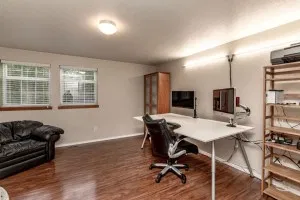
    You might want to check out the Early Office Museum if you’d like to see more early office pics. Space was made for desks, though far from perfect this was more clutter-free than today’s cubicles.  Here is a representative home office desk today:

    NewImage

    Source: CutestKidEver.org

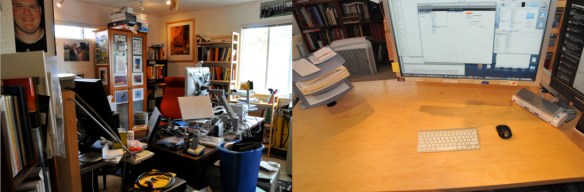
    And then an office-office cubicle environment.  The unique innovation of the modern cube is that the workspace itself is visual clutter.  But, it gets better when you have phones BBBBBBBBBRRRRRRRRringing and people talking.

    NewImage

    Source: Workspacesolutions.com

    The bottom line is that today, a desk sized to allow brains to work are considered luxuries.  And modern offices have “furniture police” (see chapter 7 of Demarco & Lister’s book PEOPLEWARE (free summery here)) who take it as their mission to impose total uniformity.

    I feel very lucky to be able to control my desk. Control is important because your desk is a way that your conscious mind can demonstrate to your unconscious mind, that the unconscious is fully respected, valued, and celebrated. Without desk control, people take sick days when they need to get something done, spreading out on the dining room table (a great starter desk!).

    Conscious?  Subconscious?  Wait!  What?

    Right now I’m reading a fantastic book READING IN THE BRAIN. This book is about the brain as computational image processing pipeline. The research reported in the book steps millimeter by millimeter through the brain mapping out which neurons are doing what.  Neurons seem to be hard wired to recognize the sub-shapes of word. Every word is a complex tree.  In the following image, see how the neurons assemble letters from the primitive sub-letter shapes in the bottom row of processing.

    Readingtext

    Source: READING IN THE BRAIN L 755

    When we put a shape in front of our eyes, we kick off large quantities of unconscious recognizing and processing.

    Unconsciousprocessing

    Source: READING IN THE BRAIN L 670


    “This view holds that the letterbox area of the brain initially evolved to recognize natural images, but not the shapes of letters or words. Nonetheless, evolution endowed it with a capacity to learn, and thus to turn itself into a reading device. Our writing systems have progressively discovered and exploited the elementary shapes that this region is capable of representing. In brief, our cortex did not specifically evolve for writing—there was neither the time nor sufficient evolutionary pressure for this to occur. On the contrary, writing evolved to fit the cortex. Our writing systems changed under the constraint that even a primate brain had to find them easy to acquire.”

    Source: READING IN THE BRAIN L 2346-2351

    I am only 1/2 way through the book, but based on what I’ve read so far, clutter triggers unconscious processing that is at the least an energy drain and at worst an energy drain + constant distraction.  Look at your desk and pretend you are a monkey.  Is there anything on your desk a monkey would be intrigued with?  We are monkeys, GTD monkeys. And clutter is intriguing to our inner monkeys.

    David Allen, when interviewed for the book WILLPOWER used a very provocative Buddhist image:

    “When he began working with overtaxed executives, he saw the problem with the traditional big-picture type of management planning, like writing mission statements, defining long-term goals, and setting priorities. He appreciated the necessity of lofty objectives, but he could see that these clients were too distracted to focus on even the simplest task of the moment. Allen described their affliction with another Buddhist image, “monkey mind,” which refers to a mind plagued with constantly shifting thoughts, like a monkey leaping wildly from tree to tree.”


    Source: WILLPOWER (pp. 77-78)

    Here is Drew Carey’s description of his desk before GTD:

    “I have self-control in some ways, but not in others,” Carey says. “It depends on what’s at stake. I just got so fed up with the mess in my office. I had boxes of paperwork and a desk I couldn’t get through. Both sides of my computer were piled up with crap and old mail. You know, it was at a point where I couldn’t think. I always felt out of control. I always knew I had stuff to do. You can’t read a book and enjoy yourself because in the back of your mind you feel like, I should go through those e-mails I have. You’re never really at rest.”


    Source: WILLPOWER (p 74)

    OK, let’s piece a couple ideas together.  First, we are evolved from monkeys (hey, God had to create us through some physical mechanism, why not evolution?) so we live in hot-wired monkey brains.  Second, we have an innate propensity to attract work and paper.  Like the Peter Principle of managers being promoted to their level of incompetence, it may well be that knowledge workers attract work to the point of “monkey mind” incompetence.

    And what is insidious is that clutter organizers, just magnify the problem.  See what Mindy Starns Clark says about organizing tools:


    “I thought that getting a house organized began with buying lots of cool holders, bins, dividers, and charts and then the stuff would almost jump inside and organize itself. I didn’t know I should never buy any organizational product unless it serves a specific function in a specific place. And even then the purchase should be made only after I’ve measured for it and determined the exact size and shape of organizer I need. In fact, it wasn’t until I began researching housekeeping in earnest that I learned that most organizational products create more mess than they help to contain.”


    THE HOUSE THAT CLEANS ITSELF p 47


  • Intervention #2: Get a reference filing system that is easier to use, than to not use. See: Evernote + Fujitsu ScanSnap

Milehighfiling

Source: Vi.sualize.us

  • Intervention #3: Do a complete mind dump.
    • Sit down for an hour with Excel, or Paper, or Word, and write down every thought that comes to mind about anything that is out of place in your life. I typically give students 20 minutes to do this in class, which I let run for 40 minutes (the student’s don’t notice because they all have a TON of open loops in their minds).  Do it for an hour the first day, and then 20 minutes a day for the rest of the week.
    • *Note* Mind dumps are a great method to get back on the GTD wagon after you have fallen off.

    NewImage

    Source: Austin Kleon

  • Intervention #4: Get a copy of THE HOUSE THAT CLEANS ITSELF and read up on the author’s ideas around “stations.” In short, the method Mindy Starns Clark uses, is to let the messes build up in your house by not cleaning.  Then, get a ladder, then climb the ladder with a camera by each mess, then take pictures looking down from the ladder, then print out the pictures, and then figure out the root cause of the mess, and design stations, to prevent the root cause from recurring. “Stations” allow you to do 100% of a job in one place, without having to make side trips to get materials or tools. In our new house, I’m going to build a charging station by the front door or the garage door once I figure out which door I’ll usually use. In the apartment I had a charging station by my desk, which was great for getting the devices on the teat, but not so good for taking them off before I left for school
    • The concept of “stations” resonates in harmony with GTD. Much of the GTD methodology itself can be decomposed into stations. The desk is a station. The phone is a station. Agendas for conversations with important people, are mental stations for future conversations.

Houseclean

Source: AllWomensTalk.com

After you have lived with GTD for three months, then try reading further into the book.  GTD is a puzzle, you need to start with the corner pieces of the puzzle (GTD chapters 1, 2, and 3) and then get the pieces assembled.  Once you have the basics down, you can move deeper into all the habits of GTD.
Hope this helps you get started with GTD!  Comment or email bill@basicip.com if you have any questions!

bill (“the” GTD excommunicatee :-) meade

Top 10 GTD Tips For Moving

Introduction:

Having just about completed my second move since starting GETTING THINGS DONE (GTD hereafter) 3 years ago, I thought I’d take a moment to reflect on how great GTD is in facilitating a move.  Bottom line, applying GTD to a move is worth 2 days of effort, cuts worry by 75%, and saves you ingesting at least a bottle, of Naproxen.

Top 10:

#10 Use Next Actions to Cull

Before you pack, go through your stuff and ask “Will this EVER have a next action?” if the answer is no, then recycle it or put it up on craigslist free.

Craigslistfree

Recycling is good, cuts about 80% of the stuff-clutter out of your life.  And, giving away is even better.  I have a hard time giving anything away that isn’t in new condition, but putting the scratch and dent stuff up will give you a great check on how blessed you are. Don’t be too proud to let someone else benefit.

I estimate the next action filter saved me moving about half my stuff and 98% of my paper reference files.

#9 Resistance Is Futile, … Reference Files MUST Be Assimilated!

If you bite the bullet now and get the Evernote pro and a scanner, you will arrive at your move’s destination, with an unbearable lightness of being … PAPERLESS!!!   Triaging your paper a month before you leave, and start scanning at least two weeks before you leave.

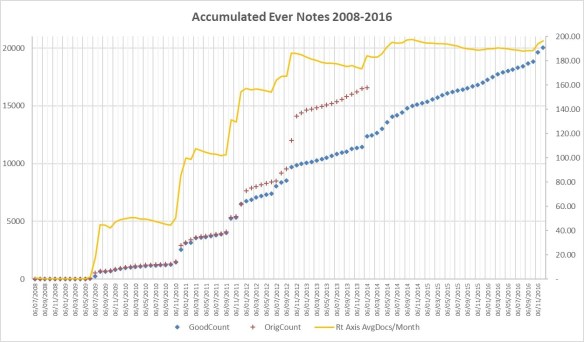
My example: I had 94,000 pages of paper in a monster 5 drawer SteelCase horizontal file cabinet.  I triaged every page, pulled out 20% that might have a next action (17,500 pages) and scanned every potentially useful page into Evernote in 4 days.  But, I know that it is hard to read these perfectly good words and reach a critical mass resolution to go to Amazon and buy the scanner and then to Evernote to buy the premium account.

If you are not convinced, please let me relate to you what happens in my 1.5 day GETTING STARTED WITH GETTING THINGS DONE classes when we cover reference filing.

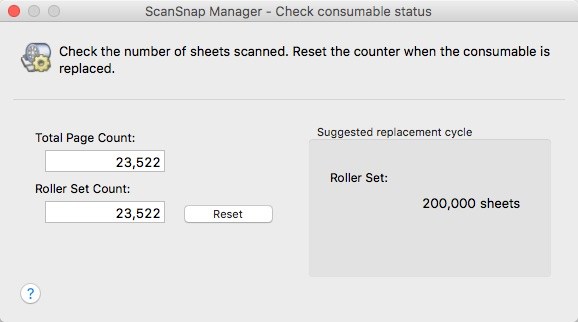
Imagine you have arrived at my class with a box of papers that need to be scanned and put into Evernote.  Great!  I sit you down to your computer and my Fujitsu ScanSnap S1500M (works on both Mac and PC) and then I say “Pick the nastiest document in your box to scan.”  You pick a 3 ringer binder from a conference you attended, pull the front cover page out, pull the contents out, remove the dividers between sections, and put the first 50 pages into the scanner.

“Wait!” I say, check the time.  It is 10:11 am.  Then, you push the scan button and the pages start feeding.  When we are 30 pages through the 50 in the ScanSnap, we put another 30 pages into the ScanSnap so it will put all the pages into one continuous file. Repeat as the next 30 pages feed, and the next, and the next, and the next, and the next. Now the binder is scanned.

Once the entire binder is through the scanner and the Fujitsu driver has gone back to sleep, we look at the clock.  Let’s see: time is 10:15 am.  Fear of scanning 0, data, 1!  This is the sufficient experiment I use to help people  produce the data they need to evaluate for themselves, the value-in-use of scanning (Shout out to you Paulina!).  So far, everyone completing this exercise has had a funny “But this was easy!” look on their face, and then they’ve ordered a scanner.  And the best part is still to come.

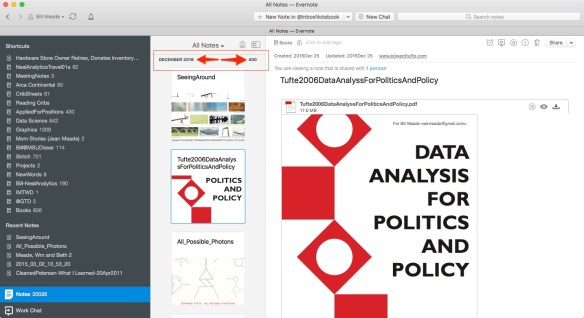
Putting documents into Evernote.  Why is Evernote the best part?  Because if you pay your $50 a year, the day after you put a document into Evernote, the document is full-text searchable.  Now not only have you recycled all your paper, but, you’ve found a way to ACTUALLY FIND your reference materials.  Search and ye shall find.  First law of evernote.

#8 Upgrade Your Desk

A move is a great time to engage in desk hegemony.  In my first post-GTD office move, I upgraded the legs of my desk to IKEA Galant “A” legs which allowed me to tilt my desk forward and fit the desk into a smaller space in my office.  In my second post-GTD office move (Today, March 2012), I upgraded to a conference table sized desk.  Here’s the first peek.

ENIMAGE1331841140262

The iMac is not on an arm yet, I have not figured out how to get goofy paper trays on the arm, but you get the idea of an even bigger mother of perfect GTD desk. Peopleware decrees that every knowledge worker should have 30 square feet of desk space in their office.  This gets me a lot closer to 30 square feet.

#7 Look for GTD-Furniture-Bricolage

I think of this as “furniture like water”.  When you are in a home, in a routine, it is just culturally normal in the USA to think of furniture solely in terms of “What’s the next piece of furniture we need?”  When you are moving, your mind can open up to new possibilities as a result of having new thoughts like:  ”I have too much furniture?!” But the very best part of furniture and moving, is GTD-bricolage.

One GTD bricolage that has been FANTASTIC for me, is when I realized the shelves in a Home Depot purchased organizer, fit into the ancient TV entertainment center where the stereo used to be.  This allowed me to put my large format Epson R1800 printer behind the dividers where the TV used to be, and all the ink and paper for the printer in the organizer behind the smoked glass, and over size paper in the entertainment center’s drawers.  People are getting rid of entertainment centers these days, they can be used for a lot of organizing, setting up stations to keep clutter out of sight.  I’ll add a picture of the entrainment print center once it is moved next week.

#6 Upgrade Your Bed

Beth and I have used a waterbed for 26 years.  Our bed gets an upgrade every time we move it (5 times so far).  This move, I upgraded the bed by making it into modules that could be assembled more quickly.  And then, once the bed was up, I drilled cable run holes through the headboards on the attached dressers.  I have no clue how I could have not thought of drilling cable holes long before now.  Now I’ve got a slick simple solution that cost $4 (Ikea Signum cable outlet kit).  Again, pictures soon.

#5 Next Action The Garage

You know you’ve been postponing doing this for 15 years.  Or at least, I was.  But a month before the movers descend on your house, have some pride, and make a “Will there ever be a next action?” pass on your garage.  This takes a lot less time than you think.  It took me three hours.  It takes my students no more than four hours.  TECHNICALLY this was covered in point #10.  But the layers of procrastination build up into a coral reef when it comes to garages.  Don’t be like me and wait 15 years to do 3 hours of work.  Just do it!

#4 Use Open-Topped Boxes

The kinds of boxes typically used for moving conceal too much information.  If you go to CostCo first thing in the morning, you can get the cardboard fruit cases (which have nice thick handles) and then pack them by station where the stuff was organized.  When you have open-topped boxes, it is easy to see what the box’s destination is.  I think you get about the same amount of stuff loosely packed in a fruit case, as you do in a standard moving box.

D3M 3221

Open topped boxes 100% sourced from CostCo for free

#3 Or, Use Your Label Maker to Make Labels As You Pack Boxes.

If you follow my advice and get a label printer, you can make a label in 10 seconds.  If you follow David Allen’s advice and get a slow alpha numeric labeler, you can make a label in a minute.

#2 Make Floor plan Of the New Dwelling

And number each room.  If you can get nothing else done, label the boxes by the room that is their destination.  Bonus points for putting up a map on the wall so that your movers or (like us) helpers from church, can easily see the location of the room number of boxes as they walk into the house.

#1 Build Two New “Stations” When You Land

Stations hark back to the most excellent THE HOUSE THAT CLEANS ITSELF.  A station is an organized work area that allows a specific job to be done without side trips for materials or tools.  The two stations I’m gong to build at our new home are: First, a charging station by the front door for phone, bluetooth headset and iPad.  And, second, a station to organize the UPS, cable modem, router, NAS, etc. in a convenient spot (at waist height or better) but, out of sight.


bill meade